Early in her career, clinical psychologist Pauline Wallin, PhD, was nervous about taking time off for the Christmas holidays. She worried she would be inundated with crisis calls while away.
Instead … crickets. Appointments dwindled during the last weeks of the year, a seasonal pattern she would observe for decades.
It turns out Dr. Wallin’s experience is common and counterintuitive.
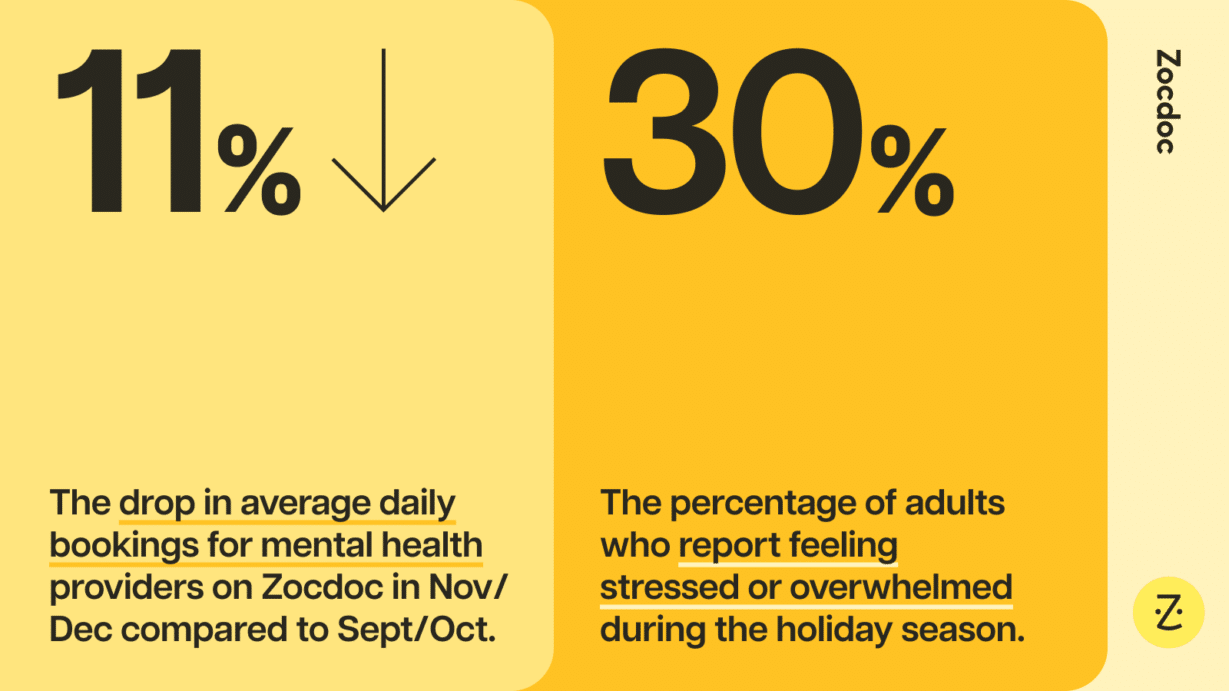
Zocdoc platform data reveals that average daily bookings for mental health providers drop 11% in November and December compared to September and October. Yet this decrease occurs as self-reported stress, anxiety, and mood changes surge. An American Psychiatric Association poll shows that 41% of U.S. adults anticipate more holiday stress, while other data shows that nearly 30% of adults feel stressed or overwhelmed during the season.
“Needing support and having the capacity to access it are two different things,” says therapist Michelle Conrad, LCPC, owner and Clinical Director of Personal Balance Counseling in Orland Park, Illinois. “Holidays compete for time, money, child care, and emotional energy. Reaching out for services becomes another task on a long list.”
Why mental health moves to the back burner
The holiday season swoops in with a perfect storm of emotional, logistical, and financial pressures that make it easy to put therapy on hold.
High levels of seasonal stress can feel temporary with a built-in deadline. “We are better at tolerating high levels of stress when we know it’s going to end,” notes Dr. Wallin, pointing out that people frequently view January 1st as a natural finish line.
It’s common to talk ourselves out of seeking help by rationalizing how we feel. As Boston psychiatrist Christine Crawford, MD, explains, adults often write off symptoms as holiday blues. “They’ll think, ‘I’m just feeling like this because it’s the holidays and I’m missing Aunt Myrtle,’ or ‘I’m sad because it’s cold and dark outside,’” says Dr. Crawford, who is also the Chief Medical Officer at the National Alliance for Mental Illness (NAMI).
At the same time, end-of-year obligations create a powerful distraction. A flurry of holiday tasks keeps people from tuning into their emotional well-being, says Joseph Niezer, MD, a psychiatrist with Corewell Health, a Michigan health system. “There’s enough distraction that people don’t necessarily sit with themselves or come up with a plan,” Dr. Niezer says.
There’s also that underlying cultural pressure to stay in the holiday spirit, which discourages people from confronting painful emotions. Opening up deep traumatic wounds or bringing up unresolved family conflicts right before a holiday dinner can feel like too much of a burden. As Dr. Wallin notes, clients routinely postpone major, life-altering conversations (like navigating a divorce) until after the season passes.
Throw in out-of-whack routines, school breaks, disrupted childcare, and the mounting financial strain of holiday gift shopping, and therapy co-pays or out-of-pocket costs often become the easiest line item to cut.
You're one click closer to care
Search and book in minutes
How to stay engaged (without feeling overwhelmed)
If you’re already getting mental healthcare (or thinking about starting), sticking with treatment during the holidays doesn’t have to be an all-or-nothing choice. Here are practical ways to make care work for you during the holidays, according to the mental health providers Zocdoc spoke with.
1. Stick to the practical stuff
Many people skip sessions because they feel they don’t have the emotional energy to dive into trauma or serious emotions during hectic holiday time, says Conrad. “We don’t have to tackle your hardest experiences or deep wounds,” she says. Instead, consider asking your therapist to focus on building skills to help you manage seasonal situations. For example, you can ask your provider to help you:
- Practice somatic or mindfulness grounding skills for stressful gatherings.
- Create a concrete boundary plan for difficult relatives.
- Process season-specific triggers, like body image or holiday grief.
2. Request flexible care options
If keeping your standard appointment slot feels challenging, talk to your provider about adjusting your setup for November and December. You might discuss shorter visits or telehealth to save on time, commute, or childcare. See if your provider offers holiday support groups. Practices such as Michelle Conrad’s run drop-in support groups specifically focused on seasonal stress. These offer therapeutic support, often at a significantly lower out-of-pocket or co-insurance costs. If retail or holiday work shifts are affecting your usual schedule, ask if your provider offers early morning, late evening, or weekend slots.
3. Don’t let “return anxiety” keep you away
If you had to cancel last minute or wound up ghosting your therapist, it is normal to feel guilty — and, in turn, avoid care. “People wonder, ‘Did I disappoint my therapist? Are they upset with me?’” Conrad explains. “People may not return because their anxiety is so high.”
Remember, your therapist is not mad at you, Conrad emphasized to Zocdoc. “You do not need an elaborate speech or apology to re-engage,” she says. “A simple email or call saying, ‘I’m ready to come back, when is your next opening?’ is all it takes.”
4. Know when care is non-negotiable
While adjusting schedules works well for low- or moderate-acuity stress, Dr. Crawford cautions that patient safety always comes first. If you are navigating an acute mood episode, experiencing active medication adjustments, or struggling with serious psychiatric symptoms, maintaining your regular visits is essential to keeping you safe and supported.
The benefits of starting now
For those thinking about starting therapy or mental healthcare, there are some distinct benefits to finding a provider toward the end of the calendar year rather than the start of the next one. Since mental health clinicians tend to have a dip in bookings around the holidays, it may be easier to get an appointment, says Dr. Wallin.
Timing care before the year’s end may also save you money. If you’ve met your annual insurance deductible, late-year sessions may only cost a copay. And if you have leftover flexible spending account (FSA) funds, there may be a limit on how much you can roll over into the new year, Dr. Wallin adds.
Looking ahead to January
If you do decide to wait until the New Year to begin or resume care, keep in mind that January brings a surge in mental health bookings as calendars clear and motivation resets. Indeed, Zocdoc platform data shows that mental health bookings jump 26% in January compared to November and December.
“All the holiday chaos passes and people realize, ‘I still don’t feel well. What do I want to do or how can I start feeling better?’” says Dr. Niezer. “There is a renewed sense of, ‘I’m motivated to make changes.’”
When that fresh-start motivation hits, finding a provider who takes your insurance and has availability can be a significant hurdle.
When you’re ready to take that step, online booking platforms can take the friction out of the process. They allow you to filter directly by your insurance coverage and book real-time openings in just a few clicks, making it easier to follow through on your good intentions.