
Competing for patients online is critical for all medical practices.
A well-planned paid search engine marketing strategy can help you set your medical practice apart from the competition, and help you acquire new patients. However, SEM can be difficult to perfect — and it’s important to ultimately understand its limitations.
Below, find some advice that can help you get the most out of your SEM strategy while also understanding when and where to invest in different levers.
Don’t assume your lowest-cost ad campaigns can be scaled.
Healthcare marketers commonly focus on two types of SEM campaigns: brand and nonbrand. With brand campaigns, they target patients looking for their specific company name. With nonbrand campaigns, they target patients looking for specialties and other types of care they offer. These are both valuable strategies, but they behave very differently.
- Brand terms: People seek out healthcare brands for a slew of reasons. They might get a referral from a friend, see a TV ad or receive an informational email. No matter the reason, it’s inexpensive for brands to bid on their own terms within Google Ads, but that low cost comes with a trade-off: low search volume. It’s difficult to scale branded search terms because there are only so many people familiar with a specific brand.
- Non-brand terms: These are specialty terms like “dentist” or “primary care.” There’s a high volume of patients typically making these searches when they’re not already considering a particular brand or doctor. While specialty terms drive the bulk of patient bookings from SEM, they are more expensive, as many practices compete for the same share of searches.
This chart outlines the behavior of different campaigns. It shows that while brand is an inexpensive strategy, the number of patients searching for a specific brand is extremely small — and the real opportunity all lies with your non-brand terms.
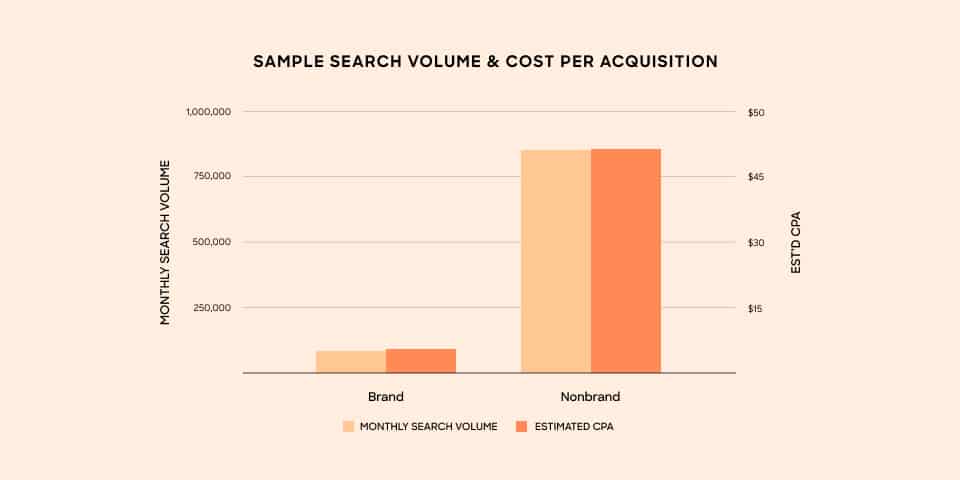
Take note: While you may look at the low cost of brand terms and mistakenly assume they can scale them, the reality is they will quickly hit a ceiling. It’s more beneficial to grow SEM campaigns around non-brand (especially specialty) terms, and it’s important to approach your growth plans with those costs in mind.
Don’t overestimate how many patients can be captured through SEM.
There are only so many patients looking for healthcare via search engines at any given moment, and ultimately, medical practices have to compete with each other for their attention.
One of the most common mistakes marketers make in this space is simply assuming the opportunity is bigger than it is. Too often, they overestimate how many patients they can attract. Understanding that there are a finite number of reachable patients on Google is crucial for determining where to allocate acquisition resources.
As the chart below indicates, in an ideal scenario, you could continue increasing you SEM spending and multiplying their bookings. But in reality, every SEM campaign eventually reaches a point of diminishing returns.
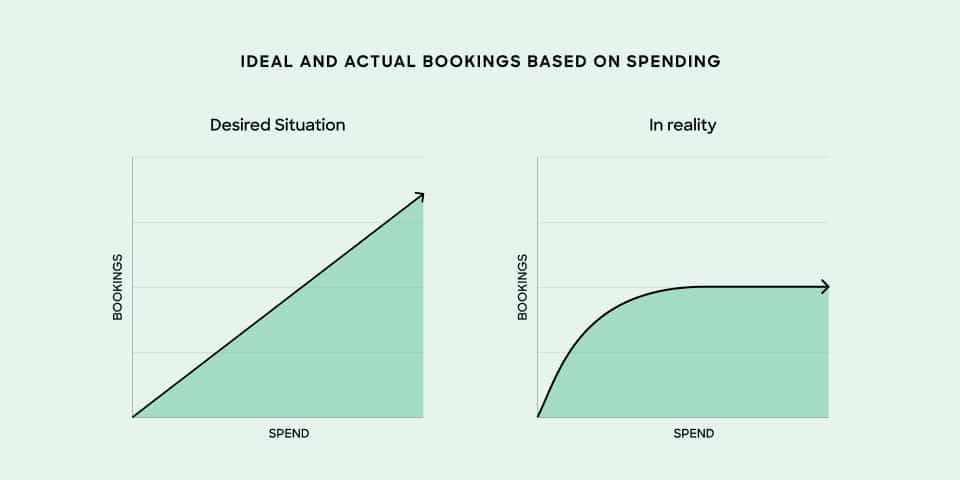
As businesses compete for patients’ attention, SEM responses diminish in two ways:
- Within Google Ads, many companies are competing for the same finite pool of searches, and at some point, the only way to get more is to bid more. However, the conversion rate typically remains the same or decreases as the cost per click increases. This drives up a practice’s CPA.
- Google aims to get ads in front of as many searchers as possible. But as it runs out of available matches, it populates ads under increasingly irrelevant searches that don’t typically translate into patient bookings. Marketers might continue to increase their Google investment without factoring this in, further driving up the cost of acquiring a new patient.
The most effective digital marketing strategists remain mindful of these factors as they scale search. They understand that after a certain point, spending more comes with higher marginal costs and decaying efficiency, and that to achieve significant growth, they need to explore additional sources of patients.
At Zocdoc, while SEM is our largest paid channel, it produces less than 20 percent of our total bookings. Diversifying our mix of marketing channels helps us continue scaling while reducing costs.
As the healthcare landscape continues to evolve, you need to remain agile. Fixing common SEM mistakes can maximize the efficiency of your digital marketing efforts — and enable you to offer care to the highest volume of patients in need of it.