If you’ve ever wondered whether there is a point when your insurance finally starts paying the full bill, the out-of-pocket maximum is the term you are looking for. Once you reach this limit, your health plan generally pays the full cost of covered, in-network care for the rest of the plan year.
However, not every healthcare expense counts toward your out-of-pocket maximum. Understanding what does and does not apply can help you better estimate your costs and avoid surprises when using your health insurance.
Key takeaways
- An out-of-pocket maximum is the most you’ll pay for covered, in-network care in a plan year before insurance pays 100% of covered costs.
- Deductibles, copays, and coinsurance for covered, in-network care usually count toward it.
- Monthly premiums, non-covered services, and most out-of-network care typically do not count.
- The deductible and the out-of-pocket maximum are not the same thing.
- Always confirm network status and your year-to-date spending before assuming you’ve hit your max.
What is an out-of-pocket maximum?
An out-of-pocket maximum is the most you have to pay for covered, in-network care in a plan year before your insurance starts paying 100% of covered costs. It’s a ceiling that’s designed to protect you from unlimited medical bills.
Let’s say, for example, that your plan’s out-of-pocket maximum is $6,000. Once your eligible costs add up to that amount, your plan pays for the rest of your covered, in-network care for the year.
How does an out-of-pocket maximum work?
You keep paying eligible out-of-pocket costs throughout the year until you reach your plan’s limit. After that, your insurance generally pays 100% of covered, in-network costs for the rest of the plan year.
Here’s a simple step-by-step example:
- You pay your deductible as you use care.
- Once your deductible is met, you pay copays or coinsurance for covered visits.
- Each of those payments adds up toward your out-of-pocket maximum.
- When your spending hits the limit, your plan pays for all covered, in-network care.
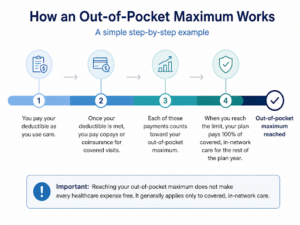
One important caveat: hitting your max doesn’t make every healthcare expense free. It applies only to covered, in-network costs.
What counts toward your out-of-pocket maximum?
Deductibles, copays, and coinsurance for covered, in-network care usually count toward your out-of-pocket maximum. These are the amounts you pay directly when you receive care.
The specifics still depend on your plan, so the exact list can vary. But in general, the money you spend on covered services within your network is what moves you toward that yearly ceiling.
Some preventative services are covered at no cost to you, even though you have a deductible and copays, as long as the provider is in-network.
Does your deductible count toward your out-of-pocket maximum?
Yes, in most plans, the amount you pay toward your deductible also counts toward your out-of-pocket maximum. So as you chip away at your deductible, you’re also chipping away at your max.
Just keep the distinction clear: your deductible is one part of what may eventually get you to the out-of-pocket maximum, but the two aren’t the same thing. The deductible is a starting point, not the ceiling.
Do copays and coinsurance count toward your out-of-pocket maximum?
Copays and coinsurance for covered care usually count too. That’s why your costs can shift throughout the year.
Early on, you might be paying down your deductible. After that, you pay copays or coinsurance for covered visits. Eventually, if your spending adds up, you reach your out-of-pocket maximum, and your plan takes over the covered, in-network share.
What does not count toward your out-of-pocket maximum?
Your monthly premiums do not count toward your out-of-pocket maximum. The premium is what you pay just to keep your coverage active, separate from what you spend on care.
Non-covered services usually don’t count either. And out-of-network costs often don’t apply to your in-network out-of-pocket maximum. Some plans set a separate, often higher, limit for out-of-network care, so it’s worth checking how yours is structured.
Medications that you pay cash for, or that you use a free trial card for, also don’t typically count towards your out-of-pocket costs.
Certain preventative care services that are provided at no cost to you also do not count towards your deductible and out-of-pocket maximum since you are paying nothing out-of-pocket.
What’s the difference between a deductible and an out-of-pocket maximum?
The deductible is the amount you pay before your insurance starts sharing more of the cost. The out-of-pocket maximum is the ceiling on what you pay for covered, in-network care in a plan year.
In other words, the deductible comes earlier in your cost-sharing journey, while the out-of-pocket maximum is the upper limit you won’t pay past.
| Deductible | Out-of-pocket maximum | |
| What it is | The amount you pay before insurance shares more | The most you pay for covered, in-network care in a year |
| When it matters | Early in the plan year | The upper limit, reached later (if at all) |
| After you meet it | You pay copays or coinsurance | Plan pays 100% of covered, in-network care |
| Counts toward the max? | Yes, in most plans | It is the max |
Ready to put this into practice? You can find doctors on Zocdoc who are in-network for your plan and book online in just a few clicks. For more, see what to know about your deductible and Health Insurance 101.
Why can you still get bills after you hit your out-of-pocket maximum?
You may still get bills if your care was out-of-network, not covered by your plan, or not included under the specific in-network out-of-pocket maximum you thought you’d met. None of that means you did anything wrong; it just means the spending didn’t apply the way you expected.
Before assuming “I hit my max,” it’s worth checking your insurer’s member portal or your Explanation of Benefits to confirm exactly where you stand.
Does out-of-network care count toward your out-of-pocket maximum?
Many plans apply the main out-of-pocket maximum only to in-network care. That’s one of the biggest reasons network status matters so much for keeping your costs in check.
If you see an out-of-network provider, that spending may not move you toward your in-network limit at all, and could fall under a separate cap. Learn how to know if a doctor is in-network and how to find a doctor who accepts your insurance.
What happens after you reach your out-of-pocket maximum?
After you reach the limit, your plan usually covers 100% of covered, in-network services for the rest of the plan year. That’s the relief the cap is designed to give you.
Keep in mind the count resets when your new plan year begins, so your spending starts over at zero.
How do you find your out-of-pocket maximum before you book?
A quick checklist can tell you almost everything you need:
- Check your insurance card and your insurer’s member portal.
- Read your Summary of Benefits and Coverage.
- See how much of your out-of-pocket maximum you’ve already met.
- Confirm the doctor is in-network.
- Look for expected cost details when they’re available.
- Call your insurer or the provider’s office if a visit type is unclear.
On Zocdoc, you can use insurance filters to see in-network providers, read verified patient reviews, view real-time availability, book online, and even see expected copay or coinsurance details for some appointments.
You can also add or update your insurance and check how much your appointment will cost before you book a visit on Zocdoc.
Conclusion
An out-of-pocket maximum is the yearly cap on what you pay for covered, in-network care, but not every healthcare expense counts toward it.
The smartest next step is to check your plan details, network status, and year-to-date spending before assuming you’re close to the limit. When you’re ready, you can compare in-network providers, see expected costs, and book care on Zocdoc.
You're one click closer to care
Search and book in minutes
FAQs
What is an out-of-pocket maximum?
It’s the most you pay for covered, in-network care in a plan year. After you reach it, your insurance generally pays 100% of covered, in-network costs for the rest of the year.
What counts toward an out-of-pocket maximum?
Deductibles, copays, and coinsurance for covered, in-network care usually count. The exact details depend on your specific plan.
Does a deductible count toward an out-of-pocket maximum?
Yes, in most plans, the amount you pay toward your deductible also counts toward your out-of-pocket maximum. The two are related but not the same thing.
Do copays and coinsurance count toward an out-of-pocket maximum?
Usually, yes, for covered care. That’s part of why your costs shift over the year, from deductible to copays or coinsurance, then eventually to your max.
What does not count toward an out-of-pocket maximum?
Monthly premiums don’t count, and non-covered services usually don’t either. Out-of-network costs often don’t apply to your in-network out-of-pocket maximum.
Why can I still get bills after hitting my out-of-pocket maximum?
You may still owe money if the care was out-of-network, not covered, or fell outside the specific limit you met. Checking your Explanation of Benefits or member portal can clear up where you actually stand.
The information in this article is provided for general informational purposes only and should not be relied on as medical advice. It is not intended as, and Zocdoc does not provide, medical advice, diagnosis or treatment. Zocdoc does not recommend any specific provider. Find one you’ll love on Zocdoc today.