
Patients don’t always tell their doctors everything. They round down the number of drinks they have per week, or skip over the medication they forgot to take. The newest omission? Taking health advice from AI.
A Zocdoc-commissioned national survey of 1,000 patients and 1,000 healthcare providers reveals why — and suggests that the fear driving the silence is largely unfounded.
Key Findings
- More than 1 in 5 patients say they’ve hidden AI use from their doctor — with Gen Z twice as likely as other generations.
- 77% of providers feel positively about patients using AI for health, and 60% would rather patients consult AI than Google.
- 88% of patients feel confident about what to do next after consulting AI, but 83% of providers say they’ve had to correct AI-generated misinformation
- Patients who trust their doctor are 17% more likely to disclose AI use and 40% more likely to book an appointment after consulting AI.
Attract more new patients
Patients are searching for care in your specialty. Are you showing up?
The elephant in the exam room
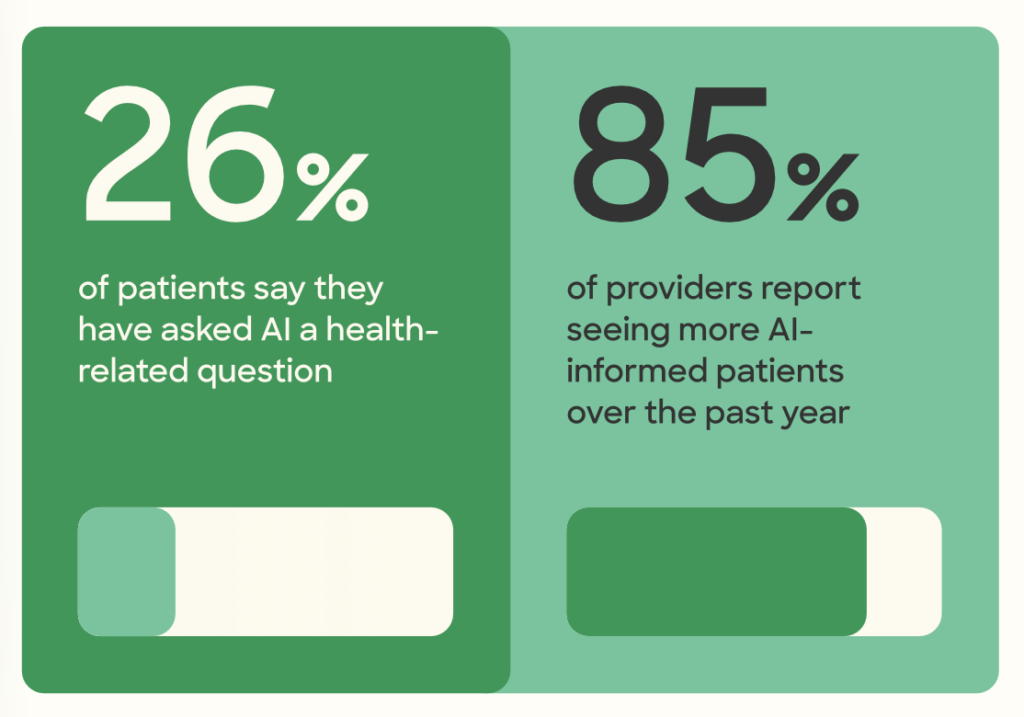
Before talking to a doctor, a growing number of Americans opens a chatbot. More than one in four patients say they’ve asked AI a health-related question, a number that nearly doubles among adults under 35. Providers have noticed: 85% say they’ve seen more AI-informed patients over the past year.
But the more revealing finding isn’t how many patients are using AI. It’s how many are hiding it. More than one in five say they’ve hidden AI use from their doctor; an additional nearly 25% say they haven’t yet but would.
The gap varies by age. Gen Z patients are the most likely to conceal their AI use: 77% say they have or would hide it from a provider, roughly twice the rate of older generations. The cohort most fluent in AI is also the most reluctant to mention it in the exam room.
The reasons for patients’ secrecy are remarkably consistent: 39% worry their doctor would judge them, 38% worry their doctor wouldn’t approve, and 31% worry their doctor would dismiss them entirely.
These fears ring familiar to internist Adam Rodman, MD, director of A.I. programs for the Carl J. Shapiro Center for Education and Research at Beth Israel Deaconess Medical Center in Boston. “What I more commonly experience is people trying to attribute [AI use] to something else,” he says. “I think it’s because they’re worried that I’ll be offended.”
But he isn’t. In fact, Dr. Rodman tells his patients that many doctors are using AI, too, and that he would rather know how it shaped their thinking than have them keep it out of the conversation.
Indeed, 77% providers surveyed say they feel positively about patients using AI for medical questions, and nearly four in five say they want patients to disclose when they’ve consulted AI before a visit.
Used well, Dr. Rodman says AI can help patients understand what they’ve been told, prepare better questions, and make the visit more focused.
Survey findings echo this: Nearly eight in 10 providers say AI-informed patients tend to ask more thoughtful questions during visits. Seventy-six percent say those patients are more engaged in their own care.
Many doctors are less concerned by patients using AI than by patients using it without support or guidance. But for some patients, that privacy is exactly the point.
Discomfort beyond disclosure
One in four patients surveyed say they would rather ask AI about an embarrassing symptom than raise it with a doctor. AI’s appeal isn’t just convenience, but the absence of a human reaction.
Cornelius James, MD, a University of Michigan internist and pediatrician who studies AI’s impact on clinical reasoning, understands the impulse. For patients who worry about judgment or mistrust the healthcare system, he says AI can feel like a lower-stakes place to start.
But that privacy comes with a tradeoff: an AI chatbot can respond without embarrassment, but also without the clinical context needed to interpret a concern in the full picture of a patient’s health.
Using ‘Dr. AI’ vs. ‘Dr. Google’
In a finding that may surprise patients, 60% of doctors say they would actually rather their patients use AI than a traditional internet search.
Large language models can personalize health information in a way search engines cannot, including around a patient’s own symptoms, lab results, or radiology reports.
Dr. James says the key distinction is what happens after AI produces an answer. AI can help organize information into something that feels more useful. But knowing what that information means for one patient, with one medical history, in one real-life context, requires clinical input.
“With Google, you’re dealing with a lot of information. With AI, you’re dealing with knowledge,” says Dr. James. “But in clinical practice, it’s wisdom — taking that knowledge and applying it in the messiness of real life — that matters.”
Sept 22: The AI Exam Room
Live roundtable on AI, access, and the future of care. Learn where healthcare goes next.
The right role for AI
Despite the disconnect around disclosure, patients and providers largely agree on what AI should be used for. The top recommended use, according to both patients and providers, is preparing questions for a doctor’s visit, cited by 36% of patients and 66% of providers. Understanding test results and feeling more informed about medical issues round out the top three on both sides.
The use case patients find most helpful reinforces the pattern: 52% say AI is most valuable for understanding what their doctor has already told them: translating jargon, contextualizing diagnoses, making sense of a visit after the fact.
In every case, the preference is to integrate AI alongside a provider visit (before, during, or after) not in place of it.
That’s also where Dr. James sees the most promise: not in patients and providers using AI separately, but in bringing that use into the open. “The reality of clinical practice in the AI era is that we’re both using it,” he says.
In that version of a visit, AI isn’t something the patient hides or the provider dismisses. It becomes something they can work through together. Dr. James says even the prompt itself can become a learning opportunity: a way for the provider to explain why one detail, such as a risk factor, medication, or piece of medical history, could change the output.
That context matters because one of AI’s most useful qualities — making health information feel personal — can also make its answers feel more certain than they are.
The confidence trap
Patients seem to understand that risk in theory, but not always in practice: 88% say they feel sure about what to do next after consulting AI, and more than one in four patients say they trust AI to provide accurate medical advice.
Yet 62% also acknowledge that AI can create a false sense of security, and 41% worry about becoming overly confident in its guidance.
That disconnect frequently follows patients into the exam room, as 83% of doctors say they’ve needed to correct information that patients brought from AI, and 63% say AI-informed patients require more visit time specifically to address misinformation.
Some 60% of providers say patient AI use can create additional work overall — creating what amounts to a time tax on an already compressed appointment.
Both sides see the risks clearly: inaccurate information is the top concern cited by patients at 57%, followed by misinterpretation at 51%. Among providers, overconfidence leads at 49%, followed by misinterpretation at 49% and inaccurate information at 45%.
It’s well known that “the sycophancy and convincingness of LLMs is a feature, not a bug,” says Dr. Rodman. These tools are built to produce responses that feel helpful, fluent, and complete — even though they can only work with the information a patient provides.
That’s where the provider relationship becomes essential. A patient may tell AI about a symptom, a lab result, or a worry. But an experienced provider can also see what’s missing. “I can see them in the room,” says Dr. Rodman. “I can see whether they’re scared. I can look at their medical record. There’s so much more context that I’m taking in.”
That is why the next step often matters more than the search itself. AI may help patients generate questions, interpret symptoms, or make sense of medical language. But whether that information becomes useful or misleading can depend on whether they have a provider they trust.
The trust factor
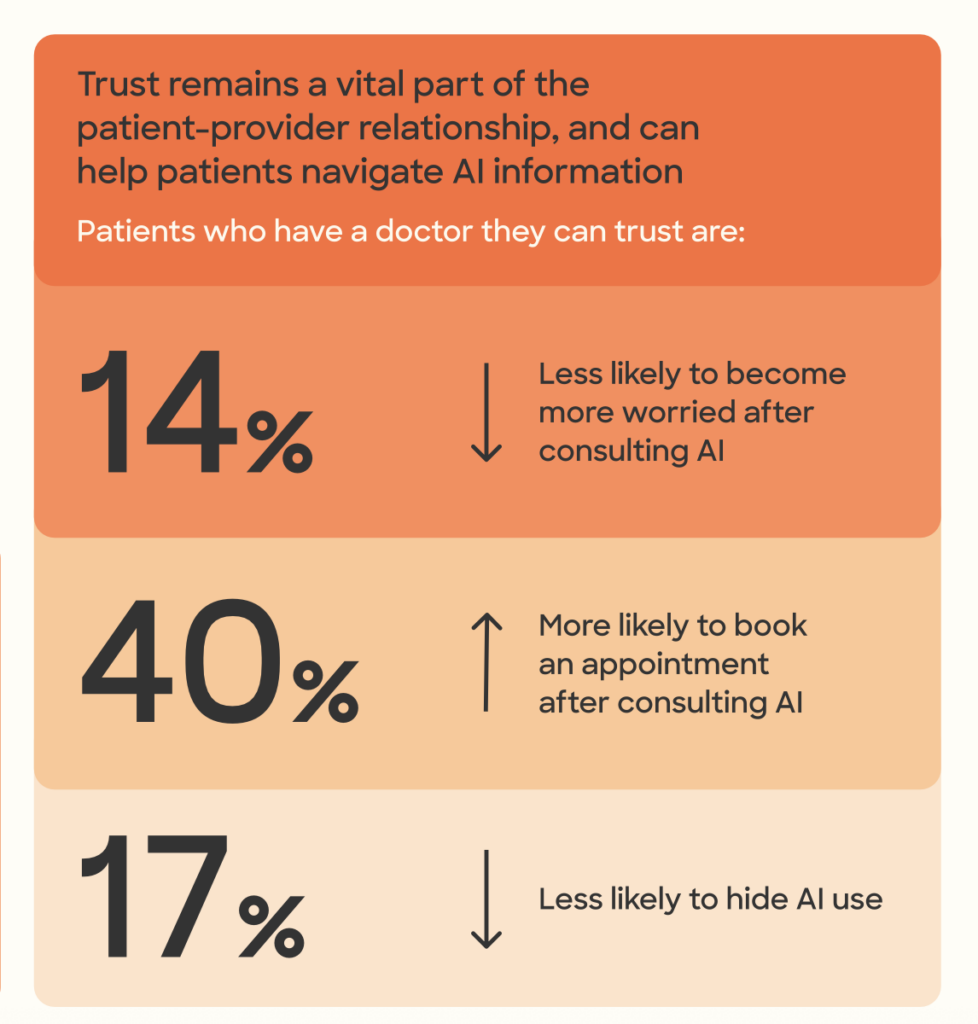
Patients who report having a trusted provider are 17% more likely to tell their doctor they’ve consulted AI. They are also 14% less likely to become more worried after using AI for health information, suggesting that a strong provider relationship gives patients a framework for evaluating what AI tells them rather than being unsettled by it.
Patients who trust their doctor are 40% more likely to book an appointment after consulting AI. Rather than replacing the doctor visit, AI paired with trust appears to encourage it. The patient researches, feels more informed, and then has a clearer next step — especially when they already know where to turn for care.
Indeed, 70% of patients surveyed said they would prefer to receive medical guidance from a doctor vs. AI, though 23% said they prefer consulting both a doctor and AI.
Dr. Rodman has seen this very dynamic play out in his research: when patients understood that an AI chat system was connected back to their doctor, their trust increased.
“It’s going to be really hard to build up trust if we’re all siloed into talking to our own AIs,” he says. “But if everyone communicates together, trust flows through the human connection, not through artificial intelligence.”
Getting there will take better tools, clearer guidance, and more AI literacy on both sides of the stethoscope. But it also starts with something more immediate: patients who can share with their doctor what they already told the chatbot.
How to bring AI into the visit
That makes preparation one of AI’s more promising roles — not as a substitute for the visit, but as a way to make the visit more focused. Dr. Rodman advises patients who use AI before an appointment to turn the output into a brief agenda rather than a sprawling list.
“Doctors love when patients come in organized and prepared,” he says. “Don’t come in with a list of 20 questions. But if you have three prioritized questions, it’s going to be a win-win for both.”
Join the platform patients trust
Attract new patients, fill your schedule, and become bookable everywhere patients look for care.