Americans are choosing doctors the way they choose almost everything else: by researching, comparing, and reading reviews online before committing. The difference is what’s at stake — not a purchase that they can return, but a relationship that affects their health, comfort, and trust. New data on what patients actually care about in their search may come as a surprise.
Key takeaways:
- Personal connection is the #1 factor when choosing a doctor, ranked 2x more important than practical considerations like location or convenience.
- Patients compare an average of 21 providers before booking, but 84% return to the same one once they find the right fit.
- 93% of appointments in 2025 were in person — even among digitally native Gen Z, 92% chose the exam room over a screen.
- 70% of Americans say they’re more worried about healthcare costs than last year — and their bookings reflect it, with 92% staying in-network.
An analysis of millions of appointments booked through Zocdoc in 2025, combined with recent national survey data, reveals what drives patient choice at each step — from first search to final booking.
Patients are looking for you right now
Show up where millions of patients search, compare, and book care.
The surprising #1 reason patients choose a doctor
When asked what matters most in choosing a healthcare provider, Americans didn’t point to location, availability, or even cost. They pointed to connection. In the Censuswide survey, respondents ranked a positive personal connection with their doctor as the single most important factor — twice as important as practical considerations like office proximity or scheduling convenience. Proximity to home or work came in second. A highly rated doctor came in third.
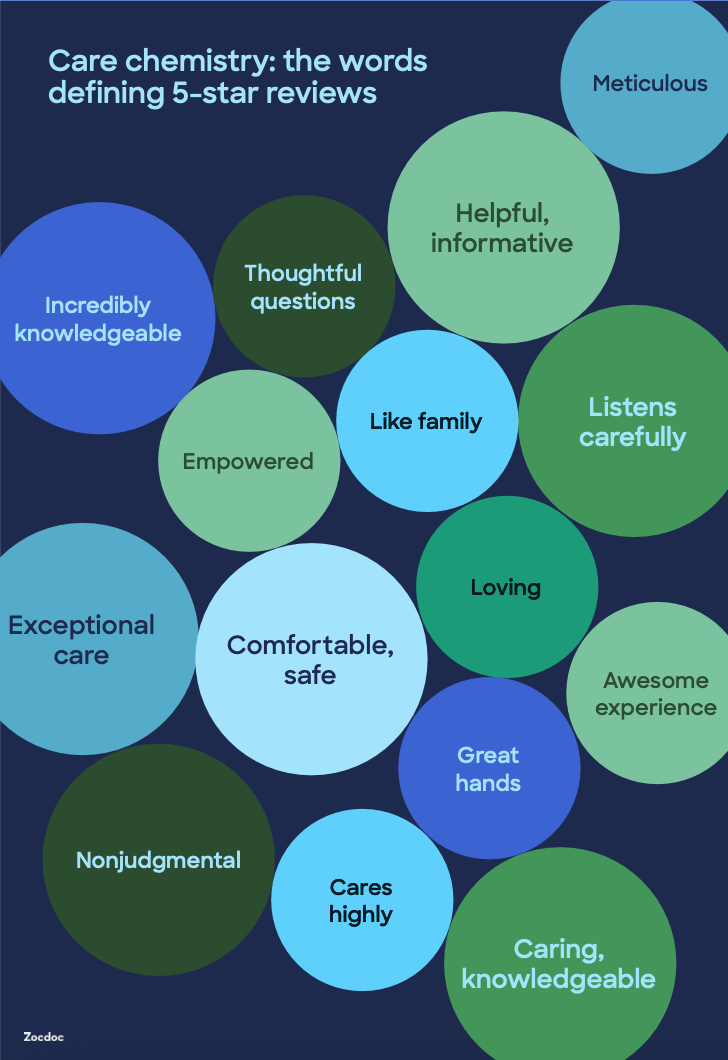
The finding might seem counterintuitive in an era of algorithm-driven recommendations and AI-powered health tools. But the language patients use when they’re actually satisfied with their care tells the same story. An analysis of Zocdoc’s review data found that the most distinctive phrases in five-star reviews weren’t about efficiency or expertise. They were about how the visit felt. Phrases like “listens carefully,” “like family,” “extremely comfortable,” and “thoughtful questions” appeared far more frequently in top-rated reviews than in any other category.
The inverse is equally revealing. The most distinctive language in one-star reviews pointed to feeling dismissed or deceived: “scam,” “excuses,” “rude.” When patients describe a bad experience, they aren’t typically complaining about wait times or parking. They’re describing a broken human interaction.
Patients do their homework, then they commit
The average patient compares 21 distinct provider profiles before booking an appointment, according to Zocdoc’s booking data from 2025. They’re comparing credentials, reading reviews, and weighing availability across dozens of options before committing.
The intensity of their research varies dramatically depending on what kind of care a patient is seeking. Those looking for a psychologist reviewed an average of 31 providers — 43% more than the overall average — before finding the right one. Patients seeking an OB-GYN viewed about 25 profiles. At the other end of the spectrum, urgent care patients compared about 16 providers, prioritizing speed over selection.
Demographics shaped the search as well. Women viewed 8% more providers on average than men. Gen X was the most selective generational cohort, viewing 4% more providers than average.
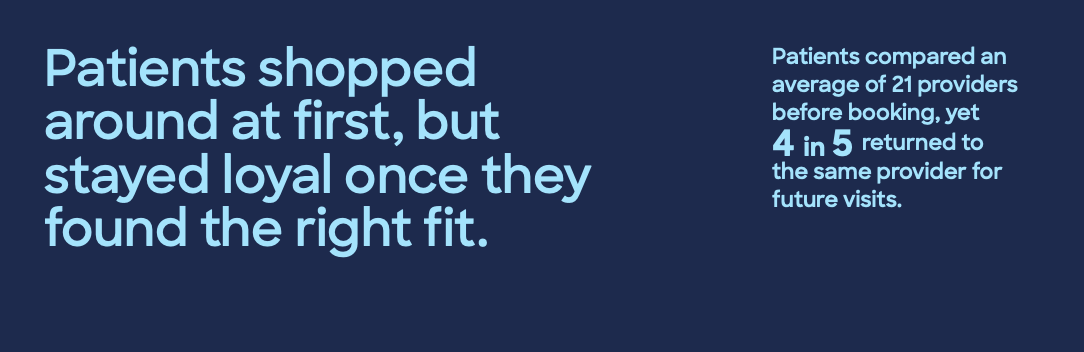
All that comparison shopping doesn’t lead to restlessness. Zocdoc’s data shows that 84% of patients who booked with a new provider returned to that same provider for their next appointment in the same specialty. The search may be exhaustive, but the commitment that follows is strong.
The loyalty rate held steady across generations, with Gen Z and Boomers both showing slightly above-average return rates.
Connection wins, but cost shapes the search
If connection is what patients ultimately look for, cost is what defines the boundaries of that choice. Seven in 10 Americans said they were more concerned about healthcare costs in 2025 than they were the year before, according to the Censuswide survey. More than one in three described themselves as significantly concerned.
That anxiety shows up clearly in booking behavior. Ninety-two percent of all appointments booked through Zocdoc in 2025 were in-network. Nearly five in six were paid for with commercial insurance. Out-of-network and self-pay bookings each accounted for just 4% of the total.
The data suggests that cost functions less as a decision-making factor and more as a gate. Patients aren’t choosing the cheapest doctor. They’re narrowing the field to providers their insurance covers, and then making their decision based on connection, reviews, and fit. Cost determines the consideration set. Connection determines the choice.
The exceptions are telling. The procedures most disproportionately booked on a self-pay or out-of-network basis weren’t emergencies or essential care. They were elective and aesthetic: esthetician consultations, filler treatments, Botox, and plastic surgery consultations topped the list. When patients chose to step outside their insurance network, it was typically for care they viewed as discretionary — a signal that in-network coverage remains a hard filter for everything else.
Nov. 10: Start 2027 Fully Booked
The practices winning 2027 are preparing now
Even Gen Z prefers the exam room to Zoom
If cost defines the boundaries of the search and connection determines the choice, the next question is where patients want that connection to happen.
After years of pandemic-driven telehealth expansion, the conventional expectation might be that virtual care would continue gaining ground. The data tells a different story. In 2025, 93% of appointments booked through Zocdoc (excluding mental health) were in person — and in-person visits rose year over year, reaching their highest share since 2020.
The generational breakdown makes the finding even more striking. Even among Gen Z — the cohort most associated with digital-first everything — 92% of appointments were in person.
Mental health was the one clear exception. Psychology and psychiatry were the only specialties where virtual care took the lead over in-person visits, reflecting both the nature of talk-based therapy and the access advantages that telehealth provides for behavioral health.
The review data reinforces why patients keep showing up in person. The language of a great healthcare experience is physical and embodied: “comfortable,” “safe,” “great hands,” “like family.” These are descriptions of being in a room with another person — of eye contact, body language, and the kind of trust that’s harder to build through a screen.
The trend doesn’t mean telehealth is irrelevant. But it does suggest that for most patients, digital tools are a pathway to care, not a replacement for it. Patients want to find and book their doctor online. They want to sit across from them in person.
A patient’s choice isn’t final until they’ve booked
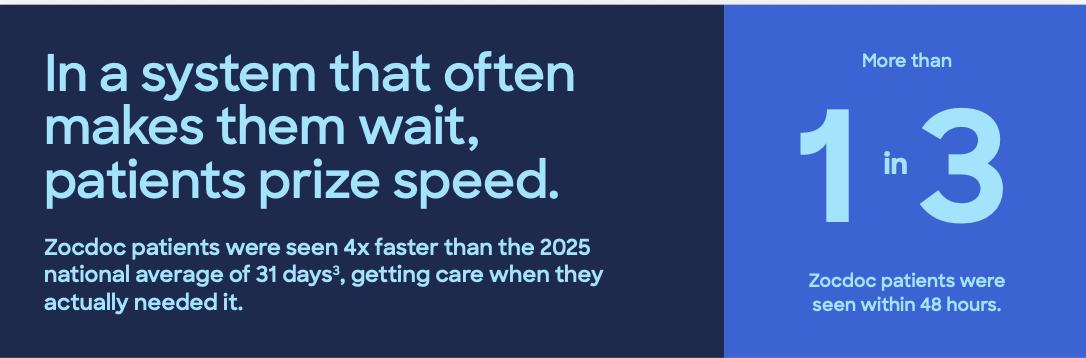
Forty-three percent of all bookings on Zocdoc happen outside of traditional office hours — evenings, late nights, and early mornings when most front desks are closed. More than half of all appointments are booked within four days of a patient deciding they need care, and 22% happen next-day. The decision window is narrow, and patients move fast once they’ve made up their minds.
Research from adjacent industries suggests that when consumers call a business and don’t reach someone within a minute, most won’t call back. The same pattern holds for online inquiry forms, where conversion drops sharply after a five-minute response delay. A patient who decides on a doctor at 9 p.m. and can’t confirm an appointment until the next morning may never come back — not because the doctor was a poor fit, but because someone else was easier to reach.
The pattern mirrors consumer behavior in other industries, where the expectation of instant confirmation has become the norm. Patients increasingly expect to book healthcare the way they book a restaurant or a rideshare: on their phone, on their schedule, with immediate confirmation. For a growing share of patients, the ability to book — not just the quality of the doctor — is becoming part of the decision itself.
Is your practice easy to find and simple to book?
Join Zocdoc to turn patient interest into booked appointments.
Sources:
- Zocdoc. Booking data analysis, Jan.–Sept. 2025. Includes provider views, booking timing, loyalty rates, insurance status, and review language. Zocdoc, 2025.
- Censuswide. National online survey of 1,000 U.S. adults, commissioned by Zocdoc, Nov. 2025. Confidence interval ±3.1%.
- AMN Healthcare. 2025 Survey of Physician Appointment Wait Times and Medicare and Medicaid Acceptance Rates. AMN Healthcare, 2025, www.amnhealthcare.com/amn-insights/physician/whitepapers/2025-survey-of-physician-appointment-wait-times/.