
By Lauren Gelman, Content Marketing Manager, Editorial at Zocdoc
Early in her career, Pauline Wallin, PhD, was nervous about taking time off for the Christmas holidays. A clinical psychologist in private practice in Pennsylvania, she worried she would be inundated with calls from clients while she was away.
Instead … crickets. Appointments dwindled during the last weeks of the year, a pattern she would observe for decades.
It turns out that Dr. Wallin’s experience is common and counterintuitive.
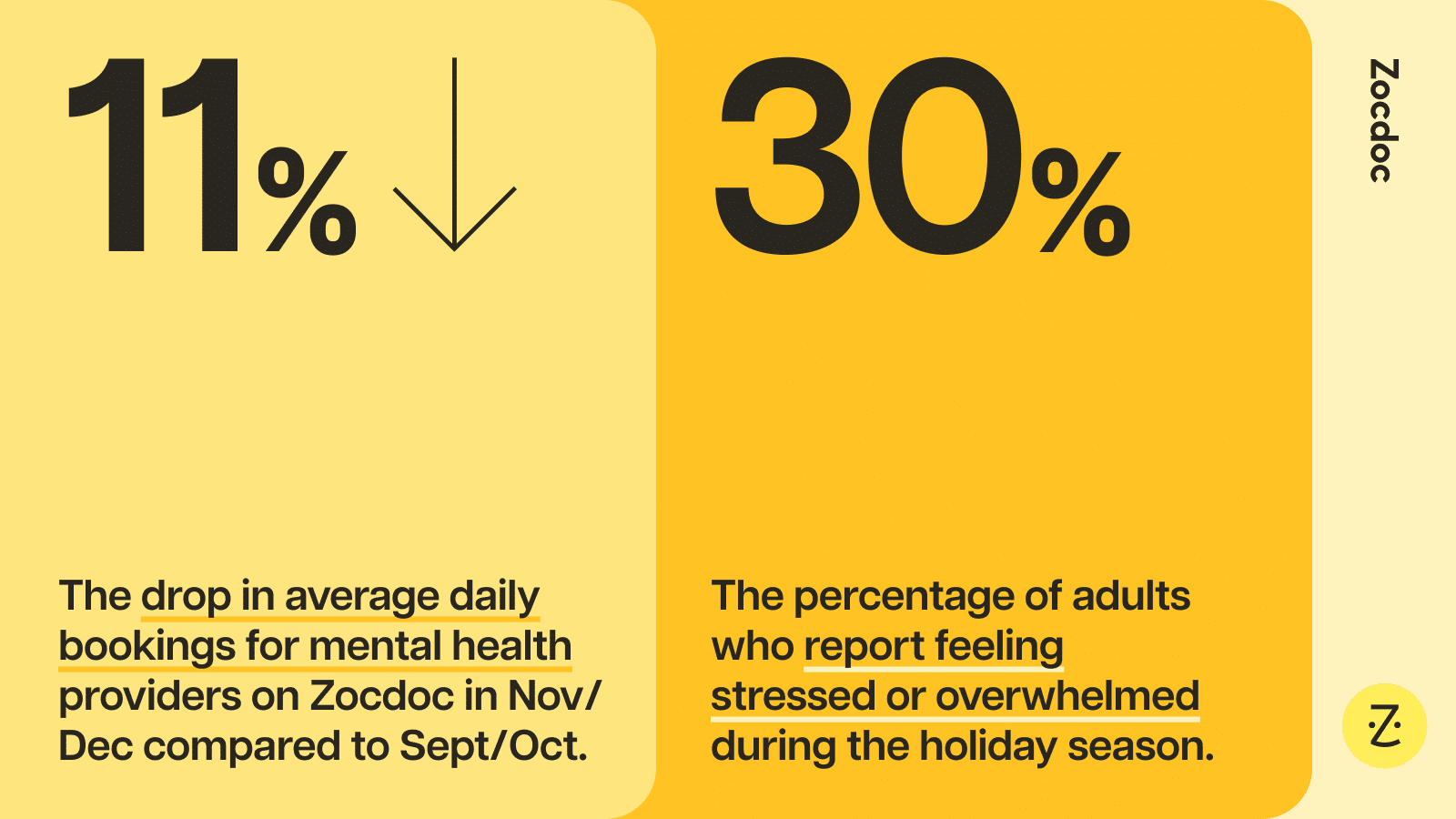
Zocdoc platform data reveals that average daily bookings for mental health providers drop 11% in November and December compared to September and October. This decrease occurs as symptoms like stress, anxiety, and mood changes surge. An American Psychiatric Association poll shows that 41% of U.S. adults anticipate more holiday stress, while other data shows that nearly 30% of adults feel stressed or overwhelmed during the season.
“Needing support and having the capacity to access it are two different things,” says therapist Michelle Conrad, LCPC, owner and Clinical Director of Personal Balance Counseling in Orland Park, Illinois. “Holidays compete for time, money, child care, and emotional energy. Reaching out for [mental health] services becomes another task on a long list.”
Why patients pause care
The holiday season swoops in a perfect storm of emotional, logistical, and financial barriers that interfere with beginning or maintaining mental healthcare.
Adults may delay starting therapy or pause ongoing care because a difficult situation feels temporary. “We are better at tolerating high levels of stress when we know it’s going to end,” notes Dr. Wallin, pointing out that patients frequently view January 1st as a natural finish line.
Christine Crawford, MD, adult and child psychiatrist and Chief Medical Officer at the National Alliance on Mental Illness (NAMI), sees adult patients talk themselves out of care by writing off symptoms as holiday- or season-related.
“They’ll think, ‘I’m just feeling like this because it’s the holidays and I’m missing Aunt Myrtle, who always hosted Thanksgiving. Or I’m sad because it’s cold and dark outside,’” she explained to Zocdoc.
A flurry of holiday obligations creates just enough distraction to keep people from tuning into their feelings, notes Joseph Niezer, MD, a psychiatrist with Corewell Health, a Michigan health system. “Then all the chaos passes in the new year, and they realize, ‘I still don’t feel well. What do I want to do to start feeling better?’”
The push to be in the holiday spirit discourages people from confronting painful emotions. Opening up deep traumatic wounds or bringing up unresolved conflicts right before family gatherings can feel like too much of a burden. Dr. Wallin says clients don’t want to confront big life transitions like divorce in the middle of the holidays. “So, we kind of postpone everything.”
End-of-year events, school breaks, and travel throw usual routines out the window. Meanwhile, affordability may be the big elephant in the therapist’s office. As holiday expenses pile up, therapy co-pays or out-of-pocket costs feel like an easy line item to cut.
The anatomy of disengagement
This trifecta of emotional overwhelm, scheduling unpredictability, and financial strain rarely translates to a well-planned hiatus. “The chaos and messiness looks like last-minute cancellations,” says Conrad. “Someone realizes, ‘Oh my gosh, I can’t make it today. Let me just put this on pause till whenever.’”
Unplanned pausing often triggers a secondary problem: return anxiety. Patients who cancel unexpectedly or ghost their provider experience guilt. “They wonder, ‘Did I disappoint my therapist? Are they upset with me? Are they mad?’” Conrad explained to Zocdoc. “People may not return because their anxiety will be so high.”
A playbook to keep patients engaged
Knowing that November and December can bring an uptick in calendar Tetris, providers can act now to get ahead of disruptions.
1. Initiate a ‘holiday temperature check’
Don’t wait until you’re ghosted to discuss schedules. Conrad recommends reaching out in early November. “It’s a conversation we start early and often: ‘What do holidays look like for you?’” Conrad says. “Is it more stressful? Maybe more peaceful? A slowdown? A pickup? More chaotic?”
Dr. Crawford agrees that planning is essential. “Talk to your patient about how it is you’re going to navigate this time together and come up with a strategy. Should we space out visits? Should we switch to telehealth? What do you think makes the most sense for you?”
When checking in, clinicians should expect patients to ask for time off. “A lot of people say, ‘I’m fine, let’s wait until after the holidays,’” notes Dr. Niezer. “People don’t want to worry about doctor’s appointments when they’re traveling or hosting. They don’t necessarily want to see their psychiatrist or therapist on their day off.”
Raising the topic early lets you map out the calendar. You can move stable follow-ups to January while keeping December open for patients who need acute support or want to use insurance before the year’s end.
2. Shift to skill-building and coping
People often feel they must show up to therapy with a heavy topic to justify a session, says Conrad. Providers can keep patients engaged by offering lighter, skill-focused objectives: grounding practices for stressful family gatherings, boundary setting with relatives, or identifying seasonal triggers like body image issues or holiday grief.
3. Provide flexible care options
Flexible formats prevent patients from making an all-or-nothing choice between full sessions or dropping out completely:
- Shorter visits and telehealth: Offer 30-minute sessions or virtual visits for clients struggling with time, childcare, or finances.
- Drop-in groups: Conrad’s practice runs weekly, drop-in holiday support groups from mid-November through New Year’s, which carry significantly lower co-insurance or out-of-pocket costs.
- Non-traditional hours: Conrad’s mid-sized group practice, which has 11 providers, offers sessions seven days a week, from 7 a.m. to 9 p.m., which helps accommodate retail and seasonal shift workers. “If someone says, ‘I work in retail so the holidays are crazy, but I still want to see you,’ we make it work,” she says.
4. Remove friction for returning patients
“Return anxiety” can keep some patients from coming back after a care hiatus. Providers can thwart this by being prompt and responsive when patients reach back out, Conrad says. “Be open and welcoming,” she says. “We want the patient to know that we want them here.”
A caveat for high-acuity exceptions
Dr. Crawford stresses that clinicians must maintain strict boundaries when safety is at stake. “If someone has a higher acuity condition, active medication changes, or an acute mood episode, they need to maintain their usual care,” Dr. Crawford says. “I need to see you in person for that mental status exam. You have to do what makes clinical sense.”
Operational adjustments
By planning for seasonal lulls, practice owners can better manage financial expectations and prepare for the January booking surge.
To ease revenue concerns, Dr. Wallin advises evaluating practice income annually or semi-annually rather than month to month. Conrad emphasizes being transparent with clinicians, especially those new to the practice or early in their careers, so they can budget for drops in income.
When cancellations leave gaps in the schedule, practices can lean on online booking offering real-time availability to patients.
However, experts caution against providers overextending schedules. “We don’t want our clinicians to open every free moment they have because they want to be there for a client,” Conrad says. Instead, providers can use downtime as an opportunity for personal self-care, administrative catch-up, or continuing education.
Prepare for the New Year surge
Zocdoc platform data shows mental health bookings surge by 26% in January as patients re-engage. This happens when the calendar flips and people realize their symptoms haven’t resolved.
“There is no longer anything [seasonal] interfering with their ability to function,” Dr. Crawford told Zocdoc. “They’ve gone through months in which they were assuming, hoping, wishing that things would improve. They’re tired and want to feel better.”
Practice owners can use December downtime to get ready for a new patient influx.
Start by evaluating your online presence, including your practice website, online directory listings, and digital booking channels, to ensure prospective patients can easily find you and seamlessly book care when their motivation peaks.
Consider investing in thought leadership on your blog and social channels. “Think about who is likely to want to start care in January,” says Dr. Wallin, who suggests writing about topics like behavior change, habits, and resolutions. “It’s important to be visible in your community,” she adds. Consider offering educational talks on popular topics like stress management or seasonal blues to local groups.
At the same time, prepare for what Michelle Conrad calls “insurance verification season.” Patients often start new policies on January 1, which can trigger a massive wave of coverage checks. She has found success with bringing on temporary admin support to help with insurance verification and preparing front-desk staff for overloaded insurance websites and extended phone wait times during the first few weeks of the new year.
Conrad also encourages group practice owners to evaluate their current case volume now. If current clinicians are near capacity, Q4 is the time to start hiring so your practice has more bandwidth in January and beyond.
Nov. 10: Start 2027 Fully Booked
The practices winning 2027 are preparing now