
By Lauren Gelman, Content Marketing Manager, Editorial at Zocdoc
When you’re used to managing daily life on your smartphone, dealing with healthcare feels painfully outdated. No wonder today’s younger adults don’t wait around when confronted with a long phone hold or a multi-month wait for an appointment. They off-ramp.
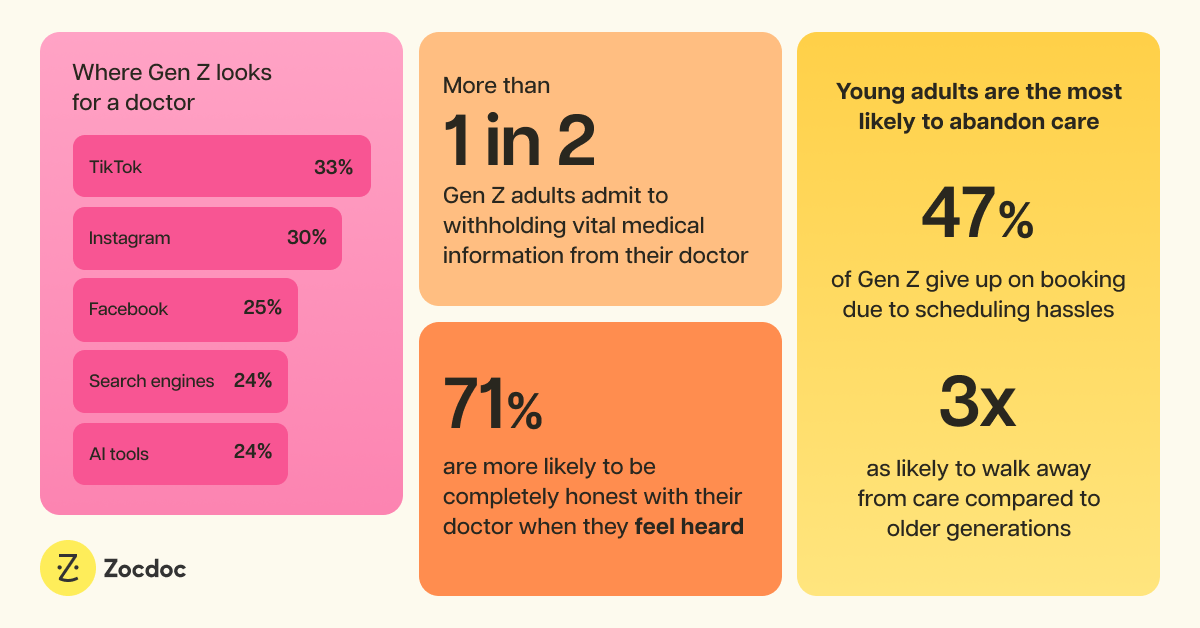
A new national survey from Zocdoc reveals that nearly half of Gen Z (47%) and Millennials (44%) have abandoned booking a medical appointment altogether simply because scheduling was too much of a hassle. Compare that to just 16% of Boomers. Faced with hard-to-book doctors, young adults are roughly three times more likely than older patients to give up on care.
Older generations absorb booking roadblocks as part of the friction of getting care. But for younger patients, they’re a dealbreaker. Roughly 60% of Gen Z and Millennials report they would ditch a provider outright for someone who is easier to book, compared to just 24% of Boomers.
Smoother scheduling gets younger patients through the front door. However, Zocdoc’s survey also showed that keeping them there requires a different kind of connection. Inside the exam room, 55% of Gen Z feel their provider doesn’t take enough time to understand them, compared to 42% of Boomers. Some 46% feel their doctor simply doesn’t get what matters to them, which is double the rate of older generations.
The result: a generation refusing to settle for outdated care models at the exact moment their long-term health needs are taking root.
Chronic care reality check
It’s easy to assume young adults skip out on care simply because they don’t have chronic conditions to worry about yet. But according to a 2025 report from the CDC, nearly six in 10 adults aged 18 to 34 are already living with at least one chronic condition, and more than one-quarter have two or more. That’s a 24% jump since 2013, and it’s largely driven by steep increases in depression and obesity, according to the report. Among young adults with obesity, nearly 60% already have a second chronic diagnosis.
The report points out that this is compounded by a system built for older patients. Younger adults are far more likely to lack consistent health insurance, which makes both preventive screenings and specialist follow-ups financially challenging. Yet, as study authors warn, meeting young adults where they are is critical for “reducing the prevalence of chronic conditions across the adult life course” and lowering the risk of early death.
That is not to say every 22-year-old needs frequent or exhaustive doctor visits.
“Managing population health amidst real capacity constraints requires smart triage and modern team-based care,” says Lyle Berkowitz, MD, an internal medicine doctor and executive chairman of the virtual care company KeyCare.
For an otherwise healthy young adult with a sudden sinus infection or minor injury, routine care can be automated online and/or managed by virtual teams. “Where we cannot compromise,” he told Zocdoc, “is ignoring early symptoms, chronic conditions, or failing to establish a baseline connection with a care team and health system altogether.”
Trying to navigate healthcare for the first time in the middle of a medical crisis is notoriously difficult. Building a baseline connection early gives young adults faster access and a seamless entry point if something becomes serious.
“You have to get them ‘in the club,’” Dr. Berkowitz continues. “Once a patient is established within a health system and attached to a care team, the entire infrastructure works for them, even if they aren’t seeing the exact same physician every time. But if you never build that initial system relationship, they stay outside until something breaks.”
Building trust in the exam room
Getting young adults “into the club” — having an ongoing relationship with a provider — is the first step. What happens inside the exam room can just as easily break the connection. As Zocdoc survey data highlighted, a majority of Gen Z patients feel their doctors don’t take enough time to understand them or grasp what matters to them.
That carries a real clinical risk. More than half (54%) of Gen Z adults surveyed admit to actively withholding vital medical information from their doctors, compared to just 13% of Boomers, largely out of fear of being judged, lectured, or dismissed.
But the inverse is telling: 71% of those surveyed report they are far more likely to be completely honest with their doctor when they feel heard.
When a visit feels rushed or transactional, someone weighing a sensitive symptom or lifestyle factor is far less likely to bring it up.
“I’m going to be a lot more hesitant when I’m at that tipping point about ‘Should I disclose this?’ in the context of a one-off visit than I will in the context of a person who I’ve come to trust,” says Brian Zikmund-Fisher, PhD, a health behavior researcher and Professor of Public Health at the University of Michigan.
The move toward DIY healthcare
So, where do young adults go when traditional healthcare doesn’t feel built for them? They start with their feeds. The old way of finding a doctor (Google search, insurance directories, physician referrals) doesn’t apply to the youngest adults. For 18- to 24-year-olds, social platforms now dominate health information gathering, according to Zocdoc survey data. TikTok leads as the top channel at 33%, followed closely by Instagram (30%) and Facebook (25%). Search engines and AI tools like ChatGPT are tied further down at 24%.
They’re also investing in wellness routines. Gen Z (43%) and Millennials (39%) are four times more likely than Boomers to spend over $100 out-of-pocket every month on self-care, supplements, and wellness routines, data shows.
“The wellness industry has caught on to the fact that the average patient is frustrated,” notes Alok Patel, MD, a health communication expert and Clinical Associate Professor of Pediatrics at Stanford Medicine.
Social media influencers and wellness platforms step directly in to fill that void. “They’re very relatable, they welcome questions, and they’re very good about listening and hearing people out. People are turning to these because they’re turned off by the traditional system,” Dr. Patel adds.
AI prompts and social feeds give young adults fast, friendly feedback, but responsiveness is not the same as a real doctor-patient relationship.
“The problems we’re running into as digital tools develop — that they can sound knowledgeable and evoke a sense of, ‘Oh, it’s listening to me’ — illustrate that what patients want isn’t just medical advice,” says Dr. Zikmund-Fisher. “They want empathy, relationship, and the feeling of being heard. That’s what care should be about.”
The on-ramp back to care
A better relationship with healthcare starts before a patient ever steps into an exam room. Zocdoc data found that half of the youngest patients say they’d rather find a different doctor than wait on hold for even a minute, a threshold only 16% of Boomers share. For this generation, administrative friction frays loyalty.
Solving these issues requires practices to reimagine how care is delivered. “We don’t have a shortage of physicians as much as we have a shortage of using them efficiently,” says Dr. Berkowitz. He points to his “SAD” (Simplify, Automate, and Delegate) philosophy to manage routine, rules-based care.
For example, digital tools can streamline phone queues, paper intake forms, and other scheduling barriers, giving the entire office a way to work faster so providers can focus more on clinical care.
“By using technology to automate administrative tasks while delegating routine clinical workflows to lower-level team members working in the office or virtually, we eliminate friction for the patient and liberate physicians to focus more of their time on complex, top-of-license care,” Dr. Berkowitz says. “This type of team-based delegation is commonly done in many specialties already, but needs to be better embraced within primary care.”
The bottom line comes down to this: “If we want younger patients to trust the medical system, we have to stop making it so painful for them to engage with it,” Dr. Patel told Zocdoc.
Removing front-door friction is one way legacy medicine earns the chance to rebuild that trust. And ensure that an entire generation doesn’t walk away before their care even begins.