
By Lauren Gelman, Content Marketing Manager, Editorial at Zocdoc
You book a doctor’s appointment and pick up a GLP-1 prescription expecting your healthcare routine to get simpler. Take the shots, lose some weight, move on.
What happens in the months that follow, though, is a different story.
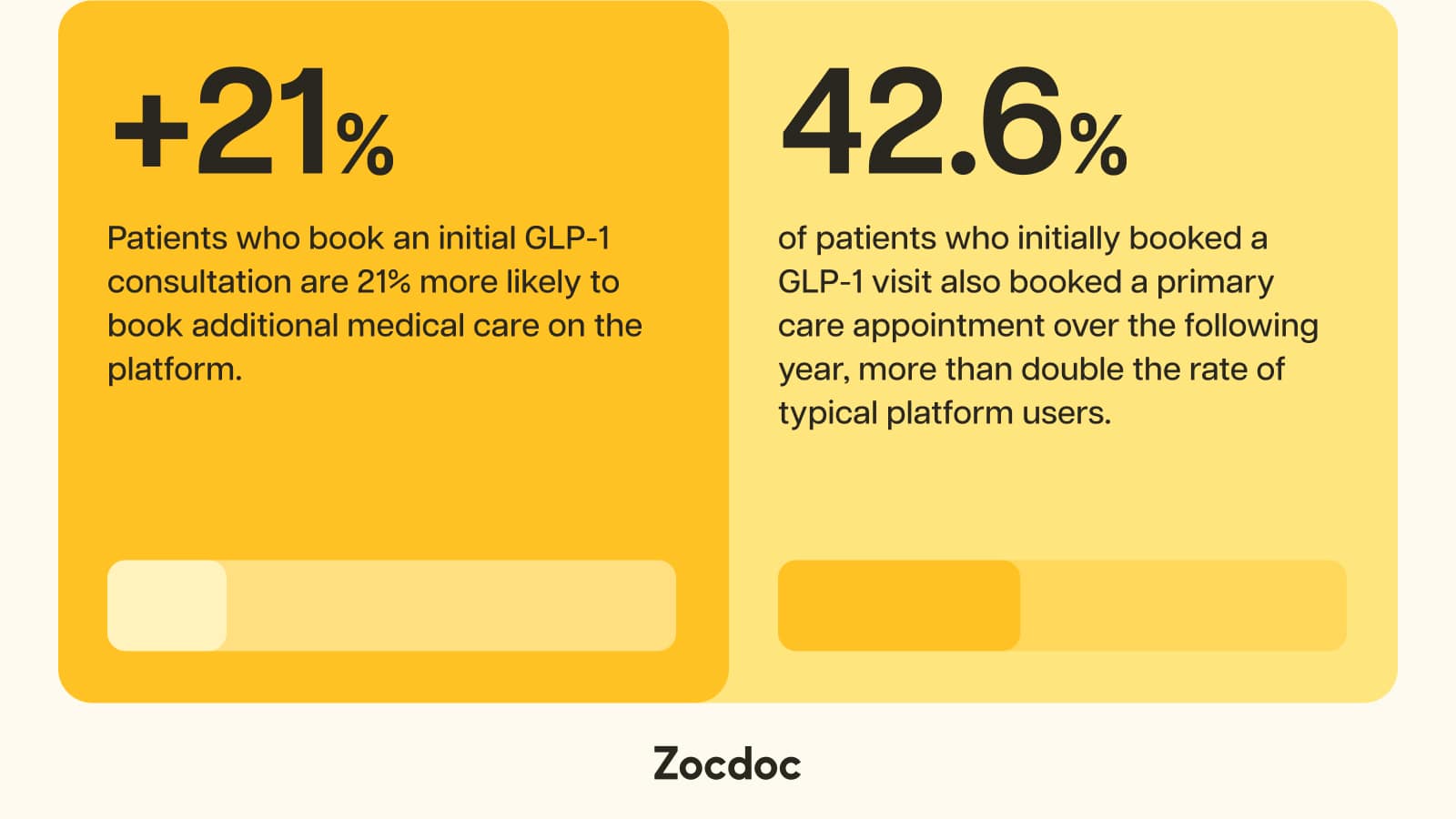
According to Zocdoc data, patients who book an initial GLP-1 consultation are 21% more likely to book additional medical care on the platform over the following 12 months compared to general Zocdoc users. Engaging in a GLP-1 consultation may act like a butterfly effect, prompting people to re-engage with their overall care in ways they hadn’t initially considered.
“GLP-1s have finally given people real, tangible success,” Amy Sheer, MD, MPH, an obesity medicine specialist and Associate Professor of Medicine at the University of Florida, told Zocdoc. “I’ve seen people completely change their health and their life in ways we weren’t seeing before.”
Rather than avoiding the doctor — a common pattern for patients who have felt judged or dismissed in medical settings — GLP-1 users are actively returning to care. They have practical questions about managing medication side effects, protecting muscle strength, and adjusting medications for chronic conditions as their bodies change.
“It really was a life-changing drug for me,” says Elissa Drassinower, who has taken a GLP-1 for four years and lost more than 50 pounds while improving her cholesterol and blood pressure. “It totally changed my health, but it also changed my relationship with my care. I’ve never seen doctors more than I have through this process.”
“[GLP-1s] changed my relationship with my care. I’ve never seen doctors more than I have through this process. — Elissa D.
Anchoring in primary care
When patients who previously booked GLP-1 consultation book follow-up visits, they first return to primary care.
According to Zocdoc data, 42.6% of patients who initially booked a GLP-1 visit also booked a primary care appointment over the following year, more than double the rate of typical platform users.
“A GLP-1 is not a static, ‘set-it-and-forget-it’ prescription,” Dr. Sheer explains. “Prescribing these medications requires active, ongoing medical monitoring. You’re tailoring doses, managing side effects, and continually adjusting care to the individual patient.”
Because GLP-1s slow down digestion, gastrointestinal issues (such as nausea, acid reflux, constipation, and diarrhea) can be common at first. Physicians may prescribe secondary medications, like anti-nausea or reflux drugs, to keep discomfort manageable while patients adjust, Dr. Sheer says.
Among patients starting GLP-1s who had no prior history of taking symptom-relief drugs, nearly 43% ended up needing a secondary prescription to manage these early side effects, Australian researchers reported earlier this year. Crucially, those extra prescriptions didn’t lead to higher ER visits or hospitalizations. Doctors were able to treat side effects within standard outpatient visits.
For many patients and providers, managing these early symptoms helps form the foundation of a collaborative “onboarding” process, in which providers use routine check-ins every few weeks to fine-tune treatment.
“A GLP-1 is not a static, ‘set-it-and-forget-it’ prescription. — Amy Sheer, MD, MPH
“If they have side effects, we have to manage those side effects,” says Jonathan Bonnet, MD, Chief Medical Officer at the Ardmore Institute of Health and Associate Professor at Stanford University School of Medicine. “We have to figure out: Is this something we treat symptomatically? Do we need to adjust the dose or stop the medication?”
When people lose 10, 15, or 20% of their body weight, their blood pressure drops, their glycemic control improves, and suddenly medications they’ve been taking for years need to be adjusted, he told Zocdoc. “This is where proactive clinical management is critical. We have to actively deprescribe to prevent over-medication.”
For Joe Coe, who has been taking a GLP-1 for almost a year, losing weight was the trigger to pay more attention to other areas of his health. “I took migraine more seriously after I lost weight,” he says. Headache and other symptoms were affecting his ability to exercise. “If I want to maintain a level of activity to keep the weight off, I need to be healthy in these other aspects of my life.”
Beyond the scale
Zocdoc booking data reveals something telling about patient expectations. When patients explicitly search for a weight loss visit, dietitians and nutritionists are their primary starting point, with primary care coming in second. But when patients search specifically for a GLP-1 appointment, 93% book directly with a primary care or internal medicine provider.
This makes sense: GLP-1s require a prescription, so visits center on a medical provider whose focus is on prescribing and monitoring. But, depending on the scope of initial care, this can leave many patients to navigate nutrition, fitness, and behavioral support separately.
“Lifestyle medicine does not equal weight loss. They are two different things,” Dr. Sheer told Zocdoc.
Because patients on a GLP-1 can lose significant weight from both fat and lean muscle mass, Dr. Sheer’s team connects them with registered dietitians, physical therapy, and fitness programs to prioritize resistance training and high-protein nutrition. Elissa’s primary care doctor emphasized eating more protein to protect her muscle mass, which prompted her to also see a nutritionist.
Dr. Bonnet emphasizes that GLP-1s create an opportune clinical window where patients feel empowered to make major lifestyle changes, including managing mental health, nutrition, and more.
“Ironically, when you’re taking one of these, you actually have to eat better than when you’re not,” Dr. Bonnet says, pointing out that smaller meal volumes make meeting protein, fiber, and micronutrient needs far more challenging. “It’s actually harder to do it optimally.”
Dr. Sheer screens for mood and body image changes, noting that rapid physical transformation often benefits from mental health support. That multidisciplinary approach aligns with how patients re-engage on Zocdoc. Platform data shows that after an initial GLP-1 consultation, patients who return for additional care are more likely than average users to book additional weight management visits, as well as appointments for mental health concerns, including anxiety, depression, and ADHD.
Care for the long haul
As GLP-1s continue to reshape weight loss and ongoing care, clinicians hope both patients and providers keep partnering on sustained, long-term healthcare engagement.
“These drugs can empower patients to take control of their health. — Jonathan Bonnet, MD
For providers, Dr. Sheer emphasizes that writing GLP-1 prescriptions requires resources to handle patient concerns about everything from GI symptoms to hair loss to accessing nutrition and mental health services. “You’re going to get questions and you’re going to have to know how to respond,” Dr. Sheer says, noting that her practice relies on a dedicated triage nurse to respond to the constant stream of patient check-ins and messages.
“I’m lucky that my doctor is very accessible to me through the portal,” says Elissa. “To be able to get my questions answered quickly, it has definitely brought me closer to my doctor in a way.”
For patients, Dr. Bonnet notes that the biggest misconception is viewing the medication as a temporary fix. Because data shows weight returns when treatment stops, starting a GLP-1 is typically an ongoing commitment — one that transforms episodic doctor visits into an ongoing partnership.
“These drugs can empower patients to take control of their health,” Dr. Bonnet told Zocdoc. “If that inspires lifestyle changes that go beyond just weight to improve overall quality of life, then that is a really good thing.”
“You have to look at [a GLP-1] as a tool to get healthy, not just something you do to lose weight rapidly,” echoes Joe. “And if you want to get healthy, there are probably other segments of your life that you have to address. What I like about my care is that they look at me and treat me as a whole person.”
Patients are looking for you right now
Show up where millions of patients search, compare, and book care.