
Sponsored Results ROI
Are Sponsored Results bringing you new patients, or ones you’d likely get anyway? We asked a Zocdoc data scientist.

Every practice that runs Sponsored Results on Zocdoc eventually asks the same question: Are my sponsored campaigns “cannibalizing” my regular bookings?
Carl Whitesel, a Senior Data Scientist at Zocdoc, hears this question more than anyone. To answer it, he ran a controlled ad experiment across 17 dermatology, dental, primary care, and mental health practices to find out how many sponsored bookings were additional (aka, incremental), and how many would likely have happened anyway through a non-sponsored listing.
We asked him about what he found.
Q: Why is that question so hard to answer?
A: Think of a grocery store running ads for a sale on pasta. If someone walks in already intending to buy pasta, the ads didn’t cause the sale. If you want to know whether your ad campaign actually brought new shoppers into the store (instead of just discounting pasta for people who already had it on their shopping list) you need to measure incrementality.
In advertising, incrementality measures the clicks that likely happen only because your ads were running. So instead of counting every person who clicked a paid ad, incrementality filters out the people who likely would have clicked your non-sponsored listing anyway. This isolates the growth driven by your campaign.
Q: How does this apply to Zocdoc bookings?
A: Most platforms use standard attribution. If a patient clicks your sponsored listing and books a doctor visit, that ad gets credit for the conversion. But that data alone can’t tell you the patient’s intent. Did they book because your ad grabbed their attention before they could see and click on a competitor? Or would they have scrolled down to the non-sponsored listings and found you regardless?
Standard attribution only tells you where the patient clicked, not what may have happened if the ad wasn’t there. The best way to answer that question is to compare what happens when some patients see your ads with what happens among a similar group of patients who don’t.
Q: That makes sense. So, how did you test this?
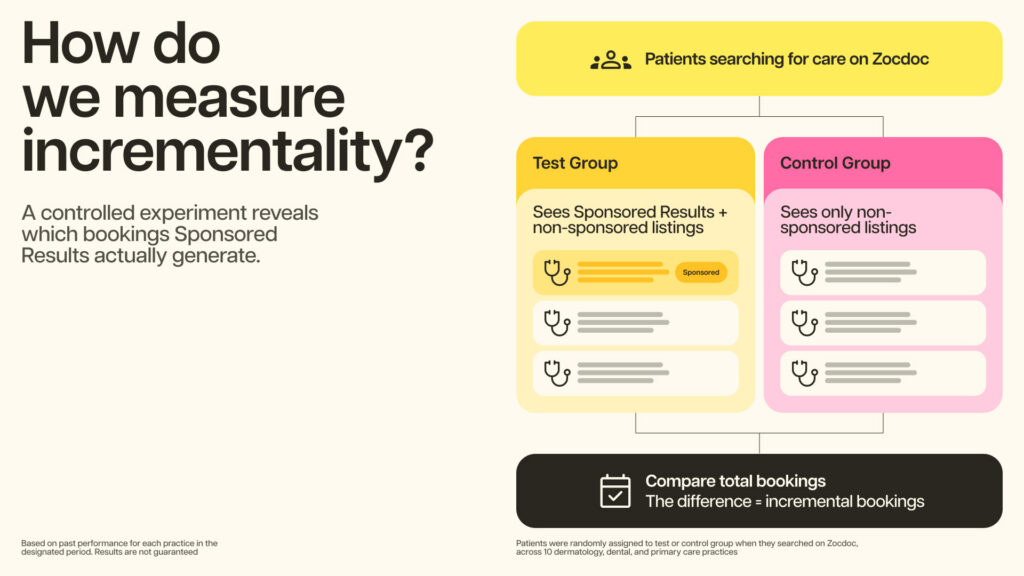
A: We ran a real-world test with 17 dermatology, dental, primary care, and mental health practices on Zocdoc. For each practice, whenever a defined set of patients searched on Zocdoc, we randomly split them into two groups. The test group saw relevant Sponsored Results listings, alongside the usual non-sponsored results. The control group saw sponsored listings except for the tested practice.
Because both groups were searching for the same care, in the same locations, at the same time, we could isolate the impact of Sponsored Results and measure how many additional bookings the ads generated.
Q: Walk me through what you saw.
A: I’ll start with one of the larger dermatology practices. They were doing well with patient growth on Zocdoc, but wanted reassurance that they weren’t just paying for bookings from patients who likely would have discovered them without the sponsored ads.
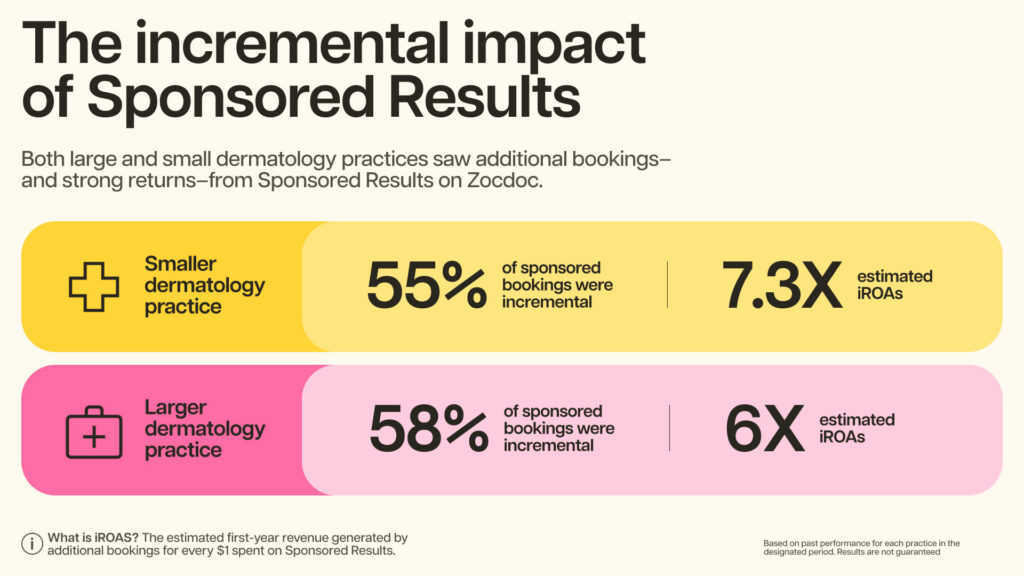
During the experiment, Sponsored Results drove a 15% lift in their total bookings. Of the practice’s sponsored bookings, we saw that 58% were incremental, meaning they were additional bookings the practice wouldn’t have received through its non-sponsored listings alone.
Now let’s compare that with a much smaller derm practice. For this group, 55% of its sponsored bookings were incremental. But Sponsored Results drove a 110% lift in total bookings.
Q: Wait, that’s a big difference between the two practices!
A: The difference in booking lift makes sense when you consider that smaller practices may start with fewer non-sponsored bookings, which gives them more room to grow.
Q: Regardless of size, practices want to know whether extra bookings justify the ad spend. Can you answer that?
A: Absolutely. Both practices saw strong returns on their investment. When we tracked the revenue generated from these bookings, the large dermatology practice saw an estimated 6x incremental return on ad spend (iROAS), while the smaller practice saw an estimated 7.3x iROAS. That means for every $1 invested in Sponsored Results, the larger practice generated an estimated $6 in first-year patient revenue, while the smaller practice brought in $7.30.
While we can’t guarantee these outcomes, this is a strong trend that shows the significant impact that Sponsored Results has.
Q: That’s for dermatology practices. What about the other specialties?
A: The same story played out across primary care and dental, too. Looking at all 17 practices in the study, Sponsored Results drove a clear increase in incremental bookings. On average, about 37% of sponsored bookings overlapped, while 63% were incremental.
Of course, that breakdown depends on a number of factors. In competitive areas — where it’s harder to show up at the top of regular search results — Sponsored Results drove the most incremental bookings. When a practice already appears prominently in non-sponsored results, more cannibalization is natural.
But across the board, the takeaway was clear: Sponsored Results consistently brought in extra bookings that practices likely wouldn’t have reached through non-sponsored listings alone.
Q: You’d think big, established practices would see more cannibalization. Did the data show that?
A: That’s what I expected, too. If you have lots of providers, patient reviews, and appointment availability, you may already appear near the top of non-sponsored listings. You’d think Sponsored Results would mostly attract patients who would have booked with you anyway. But our experiment showed that even large, well-established practices attracted additional bookings through Sponsored Results.
Q: Did anything else surprise you about the results?
A: One primary care practice revealed something interesting around seasonality. When overall search volume across their market took a typical summer dip, bookings from non-sponsored listings dropped along with it. But bookings from their Sponsored Results barely decreased.
While we can’t pinpoint the exact reason, it suggests the ads were catching the eye of high-intent searchers, acting as a safety net that increased bookings during a typical seasonal slowdown.
Q: Which kinds of practices benefit most from Sponsored Results?
A: Both smaller and larger practices can benefit, but in different ways. Sponsored Results helps smaller groups compete with larger or more established ones, and it gives large practices a way to expand into competitive markets or fill open appointment slots.
Q: How can a practice assess its competition?
A: The simplest way to check is to run a quick search on Zocdoc. Search for your visit reason or specialty using the same criteria a patient would, such as, ‘dermatologist in NYC who takes Aetna.’ Are you consistently showing up toward the top? Are there a lot of practices above you? If you’re appearing below a lot of other providers, Sponsored Results could help you gain visibility.
Q: How should practices approach bidding?
A: The biggest mistake is treating your entire practice as one uniform group. A flagship downtown clinic has different needs than a suburban satellite office. Similarly, specialized procedures may generate more revenue than routine check-ups, and thus attract more competitive bids.
If you set a uniform bid across every provider and location, you risk bidding too conservatively in highly competitive areas while overspending where your non-sponsored listings already perform well.
I recommend using visit reason targeting so you can adjust your bids based on the visit reasons you most want to attract.
Q: What’s your main takeaway about cannibalization?
A: Some degree of cannibalization is a reality in any paid advertising, but our data shows that you shouldn’t let that stop you from considering Sponsored Results as a way to grow your practice. Across the practices we studied, the majority of sponsored bookings were incremental, meaning they wouldn’t have happened without the ads.
The real question isn’t whether there’s some cannibalization. It’s whether Sponsored Results are bringing you enough additional bookings to make the investment worthwhile. And that’s exactly what measuring incrementality shows you.
Ready to be seen by more patients? Contact your Zocdoc representative to optimize your Sponsored Results strategy.

Explore more stories
- How to get ready for healthcare’s January rush New year, new patients
- Why therapy bookings drop during the most stressful months of the year Seasonal slowdown
- What per-session booking fees cost your practice Hidden fees

Get Zocdoc Insights
New reporting, research, and real voices every month, straight to you.
Go deeper


Invisible labor

Front-desk wisdom

Chemistry matters