
Use it or lose it
Where do all those expiring FSA dollars really go? 2 specialties stand out across America

The holidays have a way of turning everything into a last-minute scramble. The extra stocking stuffer. The gift card for your kid’s tennis coach. The White Elephant exchange you forgot was tomorrow.
When it comes to your health, another year-end deadline can sneak up: your flexible spending account (FSA). Some Americans are racing to use every last dollar before the end of the year, while others may not even notice their benefits clock is ticking.
FSAs let employees set aside pre-tax dollars for eligible healthcare expenses not covered by insurance, including doctor visit copays, prescription and over-the-counter drugs, and many medical supplies and health products. Unlike health savings accounts (HSAs), which generally roll over from year to year, unused FSA funds may expire at the end of the plan year.
So where does all that use-it-or-lose-it money go?
Zocdoc booking data suggests Americans have two more stops on their holiday to-do lists: the eye doctor and the dentist.
Why eye doctors and dentists top the list
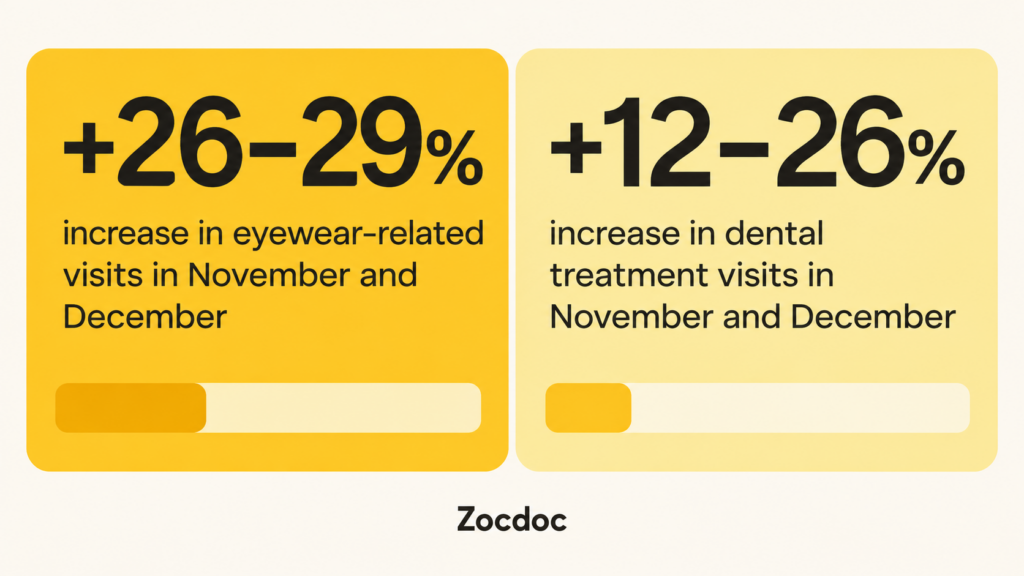
According to Zocdoc data, optometry appointments rise 12% to 19% above typical levels in November and December, while bookings for eyewear-related visits climb even higher, by 26% to 29%.
Dental appointments follow a similar pattern, increasing 4% to 12%, with dental treatment visits jumping 12% to 26%. And the momentum doesn’t stop when the calendar flips: Both specialties remain elevated into January.
While other specialties see bookings slow down around the holidays, eye doctors and dentists buck that trend.
“[Patients] remember all of a sudden, ‘Oh no, my benefits are expiring. Quick, let’s make an appointment,’” says Viola Kanevsky, OD, a New York City optometrist and past president of the New York State Optometric Association. “And everything becomes an ‘emergency’ as people are trying to get appointments.”
Sometimes it takes an expiring benefit to get patients to schedule routine care they’ve been putting off.
And while patients often arrive asking, “Okay, I have this much left. What can I do with it?” Dr. Kanevsky recommends approaching the appointment the other way around.
Let your eye doctor assess your vision and recommend the appropriate care, she says. Then work with the doctor and their staff to figure out what your insurance covers and how FSA dollars can best help with the remaining costs.
The FSA money left on the table
Not everyone manages to use their FSA funds before they expire. According to research from the Employee Benefit Research Institute (EBRI), roughly four in 10 FSA accountholders forfeited unused funds in 2024. Among those who lost money, the average amount was $404.
Younger Americans were especially likely to leave money on the table: Two-thirds of FSA accountholders under 25 forfeited some of their funds, compared with 36% of those 65 and older. Interestingly, though, older accountholders who forfeited funds tended to lose larger amounts.
Some people simply don’t think of their FSA balance as “real money,” says Virgie Bright Ellington, MD, an internal medicine physician, former health insurance executive, and founder of Medical Bill Shield.
“You’re too busy or too preoccupied to keep track,” she told Zocdoc.
How to get in before the appointment slots run out
If you still have FSA dollars to use, here’s how to make the most of them before the clock runs out.
1. Find your real finish line
Before you rush, first check your FSA balance and deadlines. Some employers offer a grace period of up to 2 ½ months, giving employees with calendar-year plans until March 15 to incur eligible expenses using leftover funds. Others allow up to $680 of unused 2026 funds to roll into 2027. Employers can offer one option or neither, so check your specific plan before assuming December 31 is your last chance.
2. Book before the rush
If you do need to spend your funds by December 31, schedule any care you’ve been putting off as soon as possible. (Go ahead. We’ll wait…)
Dr. Kanevsky has seen firsthand how quickly year-end appointments can fill up. Patients rush to schedule visits before their benefits expire, but practices can’t always accommodate the surge. “I can’t all of a sudden hire temp workers for the end of the year,” she explains, noting that eye care practices rely on trained, licensed staff.
3. But don’t call it an emergency
While the end-of-year deadline may feel urgent, Dr. Kanevsky reminds patients that “I need to use my FSA dollars before December 31st is not really an emergency.” Practices need to keep appointments available for patients with genuine medical emergencies, she explains.
If your preferred provider is booked, ask about a cancellation list. And if your own plans change, let the office know as soon as possible.
“Please, please, please give as much notice as possible if you need to cancel an appointment,” Dr. Kanevsky urges. Otherwise, “you’re taking up a slot that could be given to someone else who needs it.”
4. Get reimbursed for past visits
Those therapy copays from February? The allergist appointment you had in June? You may still be able to submit those eligible expenses for FSA reimbursement, even months after the visit.
Dr. Ellington recommends contacting your healthcare providers and requesting a transaction summary of everything you’ve paid throughout the year. That can help you identify eligible expenses you haven’t submitted, without tracking down every individual receipt. Just check your plan’s deadline for filing claims, which may extend beyond December 31.
Next year, don’t wait for the deadline
To avoid the same scramble next year, consider how much you actually spent on healthcare in 2026 before choosing your 2027 FSA contribution. Ellington recommends reviewing those expenses to help estimate how much you’ll need.
And while you’re planning for next year, think about the appointments you’ve been putting off.
“A lot of people go without routine eye care because until it really bothers them, they don’t think about their eyes,” Dr. Kanevsky says.
Consider turning her advice into one of your 2027 New Year’s resolutions: Don’t let an expiring benefit be the only reason you make an appointment next year.

Explore more stories
- How to get ready for healthcare’s January rush New year, new patients
- Why therapy bookings drop during the most stressful months of the year Seasonal slowdown
- What per-session booking fees cost your practice Hidden fees

Get Zocdoc Insights
New reporting, research, and real voices every month, straight to you.
Go deeper

Front-desk wisdom


Disrupted

September scaries